


Narcolepsy is a rare brain disorder that reflects a selective loss or dysfunction of orexin (also known as hypocretin) neurons of the lateral hypothalamus. Narcolepsy is a genetic autoimmune disease with usual onset in childhood or adolescence [1]. Narcolepsy type 1 (NT1) is characterized by excessive daytime sleepiness and cataplexy, accompanied by sleep-wake symptoms, such as hallucinations, sleep paralysis, and disturbed sleep [2]. Hypocretin level in the cerebrospinal fluid (CSF) less than 110pg/mL can confirm the diagnosis of NT1, while 20% of these patients have no cataplexy [3]. The positive HLA DQB1*06:02 allele is also frequently detected in NT1 patients, suggesting that the disease has a certain genetic background. The symptoms of narcolepsy type 2 (NT2) are similar to those of NT1, but without cataplexy, and the level of hypocretin in the CSF is normal [4]. As a chronic condition, narcolepsy can lead to decreased quality of life, including psychological issues such as depression and anxiety [5]. It is still not fully recognized by clinicians, and many patients are often misdiagnosed with syncope, epilepsy, or mental disorders. The diagnosis requires polysomnographic (PSG) recordings followed by a multiple sleep latency test (MSLT). The latter is a special daytime PSG protocol consisting of five 20-minute sleep recordings performed after nocturnal PSG every 2 hours. Average MSLT sleep latency <8 minutes, and two and more episodes of sleep-onset rapid eye movement (REM) sleep periods (SOREMPs) are required for the diagnosis of narcolepsy [2]. The treatment of narcolepsy is still symptomatic, targeting sleepiness, cataplexy, and disrupted nocturnal sleep. Narcolepsy type 2 is a less well-defined disorder, with a variable phenotype and evolution, and few reliable biomarkers have been discovered so far. Narcolepsy is frequently co-morbid with other psychiatric, medical and neurological conditions (depression, bipolar disorder, restless leg syndrome, periodic leg movements disorder, headache, and other conditions) [5]. In particular, cases are reported about co-occurrence of narcolepsy and epilepsy [6-8]. Also, it may be a cause of diagnostic misinterpretation for epilepsy [9,10]. Diagnostic confusion between narcolepsy and epilepsy may arise because both conditions can present with sudden loss of muscle tone, automatic behaviors, unresponsiveness, sleep attacks, and other features.
CASE PRESENTATION
We report a 15-year-old boy (BMI 20.3kg/m2) with normal psychomotor development and no family history of narcolepsy or epilepsy. At the age of 12, the patient developed excessive daytime sleepiness (EDS), complaining of falling asleep easily, sometimes experiencing episodes of temporary inability to move after awakening. His mean total sleep time was 12 hours, and if his sleep lasted less, he experienced sleepiness throughout the day. The patient had episodes of sudden onset of sleep and reported having sudden episodes of crying lasting 1-2 minutes. He did not report vivid dreams at the beginning of sleep or right after awakening in the morning or any episodes of emotionally-triggered muscle weakness (cataplexy). The patient usually woke up 2-3 times per night, feeling that the sleep quality was not satisfactory. His physical and neurological examinations were normal.
Past medical history: Epilepsy since age of 4 years old with bilateral tonic-clonic seizures. The seizures occurred only in sleep, closer to morning, with tonic and clonic movements and head tilt. The seizures lasted 3-4 minutes, with a frequency of about 1 per month. At this age, routine EEGs showed epileptiform discharges. The patient was treated with phenobarbital, 100mg/day. At age 12, phenobarbital was tapered off, while the last seizure was reported at age 9.
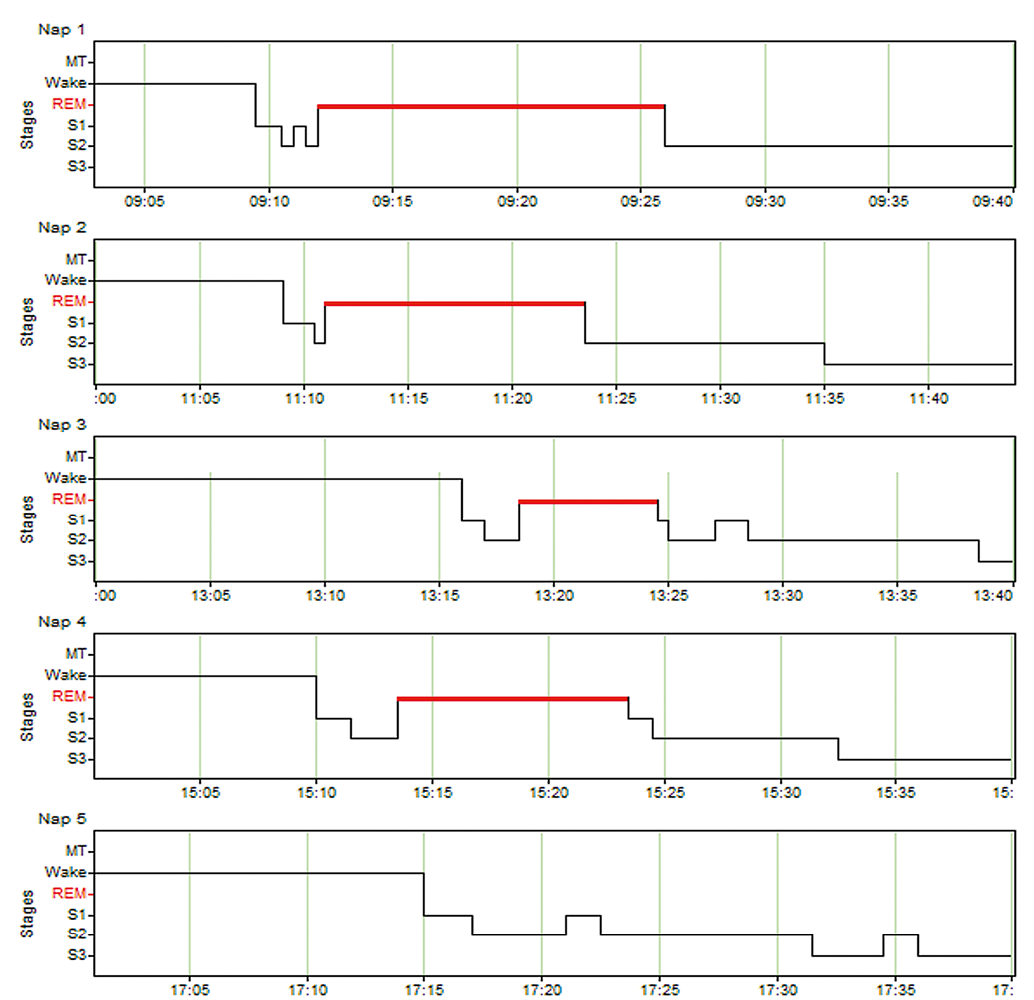
Diagnostic Workup: The patient underwent PSG combined with EEG monitoring (PSG-EEG) followed by MSLT. No sleep or epileptiform abnormalities were seen on the PSG-EEG recording, with normal respiratory and leg movement indexes; MSLT showed that the average sleep latency was 7.8 minutes, and 4 SOREMPs were observed out of 5 naps; sleep episodes were detected in 4 naps, and the average REM latency was 12.9 minutes (Figure 1). The patient was negative for narcolepsy-associated HLA DQB1*06:02 and HLA DRB1*15:01 alleles. The CSF hypocretin testing was not available. The findings were consistent with the diagnosis of NT2 accompanied by sleep disruption and sleep paralysis.
Management and Outcome: Initial treatment included non-pharmacological strategies: sleep hygiene and scheduled daytime naps. Pharmacotherapy with modafinil 100mg/day was initiated with positive effect on EDS.
DISCUSSION
In the presented case, a 15-year-old teenager was complaining of daytime sleepiness, inability to move after awakening at night, and falling asleep easily during the day. His medical history and records were remarkable by epilepsy with the last seizure registered at age 9.
This case presents a diagnostically and clinically complex medical history involving NT2 in a 15-year-old male with a remote history of self-limited epilepsy and current complaints of EDS, sleep paralysis, and poor nocturnal sleep quality. Misdiagnosing NT1 as generalized epilepsy is not rare in clinical practice, especially in children with a recent onset of disease [9]. Unrecognized or misdiagnosed symptoms of narcolepsy contribute to increased morbidity, disability, and socioeconomic liability in these patients [11]. Despite distinct description of epileptic seizures and appearance of clinical symptoms characteristic of narcolepsy that developed some time after them, the issue of distinguishing between such neurological diseases in the pediatric population remains important. In the current case, the onset of sleepiness and some other symptoms of narcolepsy occurred at the same age when the antiseizure medication (ASM) was stopped although without direct connection. Of course, daytime sleepiness could also have occurred earlier due to nocturnal epileptic seizures, sleep fragmentation or ASM, but in this case, we had associated episodes of daytime sleepiness and polysomnographically confirmed diagnosis of NT2. As the cases of co-morbid epilepsy and narcolepsy reported in literature are scarce, it is important to reveal such patients to understand further the nature of this relationship [6-8,12]. Although the sequence of epilepsy and narcolepsy in the current case-description could be simply occasional, considering the existence of the above-mentioned case reports of co-morbidity between the two may shed light on a possible deeper connection. Moreover, there are other examples of frequent co-morbidity of epilepsy and sleep disorders. Close reciprocity between sleep-related hypermotor epilepsy (SHE, formerly known as nocturnal frontal lobe epilepsy) and the disorders of arousal (NREM parasomnias) is shown in a familial aggregation study [13]. Many narcolepsy symptoms, such as cataplexy, sleep attacks, and automatic behavior, can resemble focal or generalized seizures. Conversely, nocturnal seizures and postictal drowsiness can mimic narcoleptic sleepiness [9]. The coexistence of narcolepsy and epilepsy has been documented in both focal and generalized epilepsy types (e.g., temporal lobe, juvenile myoclonic epilepsy) [6,7]. Some authors propose that hypothalamic dysfunction, orexin deficiency, or autoimmune mechanisms could influence cortical excitability, creating a predisposition for seizures or abnormal sleep regulation [8]. The study by Fulong et al. (2021) aimed to investigate morphological and age-related changes in the brains of patients with narcolepsy, using neuroimaging techniques to examine cortical thickness, gyrification, and structural alterations [14]. The authors sought to determine how narcolepsy affects brain development and long-term brain structure, providing insight into potential neural correlates of sleep-wake dysregulation and its overlap with other neurological disorders, including epilepsy. In adolescent patients with narcolepsy, the frontal lobes showed altered brain morphology – notably a thinner cortex and increased gyrification – and these changes may persist from adolescence to young adulthood, indicating long-term structural changes. Thus, there could still be currently unclear mechanisms involved, creating a common basis for both conditions. To the best of our knowledge this is the first case to report development of narcolepsy in a patient with a history of self-limited epilepsy. This case underscores the importance of considering NT2 in adolescents presenting with chronic excessive daytime sleepiness, despite the presence of previous neurological disorders such as epilepsy. Timely diagnosis and treatment can significantly enhance functional outcomes and quality of life.
Fig. 1. Multiple Sleep Latency Test (MSLT) hypnograms (naps), confirming the patient’s narcolepsy diagnosis, with 4 out of 5 naps accompanied by sleep-onset rapid eye-movement sleep periods (SOREMPS, in red) recorded (2 are enough). Acronyms: S1-S3 refer to non-rapid eye movement (NREM) sleep stages 1-3. Courtesy of Somnus Neurology Clinic.
References
- Han F, Lin L, Warby SC, et al. Narcolepsy onset is seasonal and increased following the 2009 H1N1 pandemic in China. Ann Neurol. 2011;70(3):410-417.
- American Academy of Sleep Medicine. The International Classification of Sleep Disorders (ICSD-3). (American Academy of Sleep Medicine, ed.). Darien, IL; 2014.
- Arii J, Kanbayashi T, Tanabe Y, et al. CSF hypocretin-1 (orexin-A) levels in childhood narcolepsy and neurologic disorders. Neurology. 2004;63(12):2440-2442.
- Barateau L, Pizza F, Plazzi G, Dauvilliers Y. Narcolepsy. J Sleep Res. 2022;31(4):e13631.
- Verstraete L, Van Den Bossche M. Narcolepsy and psychiatric comorbidity: a review of the literature. Int J Clin Health Psychol. 2025;25(2):100591.
- Klobucnikova K, Siarnik P, Muchova I, Štofko J, Kollar B. The comorbidity of focal epilepsy and narcolepsy type 1 – two case reports. Neuro Endocrinol Lett. 2018;39(2):95-98.
- Joshi PA, Poduri A, Kothare SV. Juvenile myoclonic epilepsy and narcolepsy: A series of three cases. Epilepsy Behav. 2015;51:163-165.
- Yang Z, Liu X, Dong X, et al. Epilepsy and narcolepsy-cataplexy in a child. J Child Neurol. 2012;27(6):807-810.
- Macleod S, Ferrie C, Zuberi SM. Symptoms of narcolepsy in children misinterpreted as epilepsy. Epileptic Disord. 2005;7(1):13-17.
- Singh AK, Saha A, Dutt N, Mohapatra PR, Janmeja AK, Bansal A. Narcolepsy presenting as refractory epilepsy. Indian J Pediatr. 2009;76(10):1073-1073.
- Morse AM. Narcolepsy in children and adults: a guide to improved recognition, diagnosis and management. Med Sci. 2019;7(12):106.
- Baiardi S, Vandi S, Pizza F, et al. Narcolepsy type 1 and idiopathic generalized epilepsy: diagnostic and therapeutic challenges in dual cases. J Clin Sleep Med. 2015;11(11):1257-1262.
- Bisulli F, Vignatelli L, Naldi I, et al. Increased frequency of arousal parasomnias in families with nocturnal frontal lobe epilepsy: A common mechanism? Epilepsia. 2010;51(9):1852-1860.
- Fulong X, Spruyt K, Xiaosong D, et al. Morphological and age-related changes in the narcolepsy brain. Cerebral Cortex. 2021;31(12):5460-5469.