


The problem of psychopathological qualification of rudimentary, clinically immature symptoms in the clinical picture of mental illnesses has existed for a long time; however, it has rarely been the focus of psychiatric research. As a rule, in recent years rudimentary phenomena have been studied within the framework of works on psychopathological diathesis [1], within the framework of identifying the “attenuated psychosis syndrome” as a condition of high clinical risk of disease development [2]. However, psychopathological phenomena of varying degrees of maturity are found in the clinical picture after the onset of the disease, in the advanced stages of the disease. On the one hand, it is believed that the proportion of poorly differentiated, syndromically unformed symptoms is a possible consequence of the pathomorphosis of mental disorders, apparently of a pharmacogenic nature [3], on the other hand, it seems obvious that clinically immature symptoms are a stage in the evolution of the psychopathological syndrome, demonstrating possible paths for further development of the disease. Particular difficulties arise when attempting to qualify rudimentary pathological phenomena of bodily sensitivity, since even for mature symptoms of the senesthetic-coenestopathic (sensopathic) group, as a rule, there are no precise definitions [4]. The problem is further aggravated by the constant change in headings and terms in the psychiatric section of modern international classifications [5]. Despite the fact that the concept of cenesthopathies was initially developed in the French and German classical psychiatric schools, at present this concept is practically excluded from the dictionary of international classifications. In English-language publications, the majority of such cases, depending on their characteristics, are attributed either to hyperesthesia or to hallucinations [6]. In addition, the clinical picture of cenesthopathies largely overlaps with the modern understanding of neuropathic pain, which belongs to the area of neurology [6]. However, the exclusion of the term cenesthopathies from the dictionary of international classifications does not eliminate the problem of cenesthopathies itself, which seems to be still poorly studied and relevant. Patients with pathological bodily sensations of the cenesthopathic circle regularly see psychiatrists. Accordingly, the doctor needs to understand the features of diagnostics of symptoms of the sensopathic group and the patterns of their further dynamics to provide adequate assistance to the patient.
The aim of this study is to investigate the general patterns of symptom formation in patients with pathological bodily sensations of the sensopathic group.
MATERIAL AND METHODS
The main group included patients with pathological bodily sensations (cenesthopathies) who met the following criteria:
- sensations arise without any real physical basis – the description, localization and other characteristics of sensations do not fit into the clinical picture of known somatic diseases; medical examinations do not reveal physical damage in the patient that corresponds to the severity of their condition;
- sensations are accompanied by a specific accentuation of self-awareness on the processes of the somatic sphere, which is clinically manifested by a persistent dominance in consciousness of unusual, strange, alien, painful, difficult to describe sensations of unusual localization and high sensory saturation.
A total of 105 patients were examined (47 males and 58 females; average age 43.1±1.36 years, average duration of the disease 10.1±0.9 years), who were divided into three subgroups: 1) schizophrenia spectrum disorders (58 people); 2) organic mental disorders (32 people); 3) affective disorders (15 people).
The direct subject of the analysis was the patients’ statements, i.e. 241 descriptions of cenesthopathies. We did not limit the patients in describing pathological bodily sensations either by time or by a unidirectional interest exclusively in cenesthopathies. We recorded on a dictaphone all bodily sensations that went beyond the normal sensitivity and were not associated with a somatic disease. The statements were then analyzed using a complex clinical-semantic approach, and the results of the analysis were subjected to statistical processing (more details on the methods and material) [7,8].
RESULTS
When analyzing the statements, it became clear that cenesthopathies themselves are not homogeneous. In some patients (109 statements), cenesthopathies were the only manifestation of altered bodily self-perception. In the remaining cases (132 statements), cenesthopathies were either accompanied by other pathological phenomena characterizing changes in the somatopsychic “I”, or were themselves a component of more complex pathological formations (for example, sensory automatisms). This meant that cenesthopathies in the structure of other syndromes or cenesthopathies accompanied by pathological bodily phenomena different from them were more common (54.8%) than cenesthopathies as a monosymptom of altered corporeality (45.2%; χ2 = 4.4; p < 0.05).
In addition, among the statements there were many sensations, a clear psychopathological qualification of which did not seem possible at all, and the features of their verbal representation revealed only similarities with somatopsychic depersonalization, visceral hallucinations or sensory automatisms.
Clinical illustrations of complex sensopathic syndromes
Somatopsychic depersonalization
Most often, pathological bodily sensations were accompanied by somatopsychic depersonalization of varying degrees of severity – from a weak and undifferentiated feeling of change in one’s own bodily sensations to a fully formed depersonalization syndrome.
In mild somatopsychic depersonalization, we encountered an undifferentiated feeling of change in one’s own bodily sensations, which, unlike cenesthopathies, was not the leading disorder of the somatopsychic “Self”. These disorders could be detected by conducting a special additional questioning. In the descriptions of mild depersonalization disorders, differentiated definitions were almost completely absent. For example, sensations were described as follows: “it’s like a transition”, “like nausea”, “like it doesn’t work right, like it’s not mine - in the sense that it’s mine, but somehow I don’t feel it right”. As a rule, there was no specific localization of sensations (usually the experience concerned the entire body).
Examples of statements with mild depersonalization: “Nausea throughout the body... everything somehow doesn’t work right”; “I feel inside myself... physical discomfort.”
An example of a complete syndrome of somatopsychic depersonalization: “I am frightened by the strangeness of the sensation, I can’t explain it to you... I don’t feel my body, I don’t feel anything... I press my lips together - and I don’t feel anything... when someone touches me - I can feel it, but the sensation is somehow different than before... In general, I have the feeling that this body is not mine. In general, I don’t feel my whole body... I even tried walking barefoot on gravel, I didn’t feel it... I wring out a rag, it even breaks in half from wringing – that is, I have strength, but I don’t feel this rag... for me it is very painful... this shouldn’t happen.”
Visceral hallucinations
In intermediate forms of pathological sensations (between cenesthopathies and visceral hallucinations), metaphorical comparisons denoting the source of bodily suffering appeared in the patients’ statements. Comparisons were made with physical objects of reality, which, in the patient’s opinion, could cause similar sensations. Then the objects were designated (usually by nouns) and described in the same way as surrounding objects are usually described. Duality appeared in the patients’ speech: on the one hand, sensations were described as produced by an object actually existing in the body, on the other hand, the patients did not have the conviction of the real existence of a foreign body inside themselves, which is necessary for the hallucinatory disorders that had formed (when asked directly, the patients categorically denied this).
When the syndrome was formed, pathological sensations were an integral part of visceral hallucinations.
Examples of intermediate forms of sensopathies (between cenesthopathies and visceral hallucinations): “As if between the skull and the skin there are some kind of spots of something that has some dimensions and crawls... something very flattened, flat... a reptile, some kind of amoeba... Not amoebas, I understand that this is all nonsense...”; “It’s as if there’s someone sitting in the area of the liver... something hard... leaning on me, sometimes moving, burning... as if something iron is standing there, like a support.”
Examples of formed visceral hallucinations: “The thread from the head... goes from the mouth into the head and comes out from the top... it has no color, it is stretched”; “Under the skin I feel... some scrolls... I feel that they have risen upwards... a sensation under the skin and in the muscles, between the muscles maybe even... I feel a foreign body in the body... in the heart, in the intestines - no, but only in the muscles. The body has pushed everything into the muscles, under the skin.”
Sensory (cenesthopathic) automatisms
In phenomena intermediate between cenesthopathies and sensory automatisms, in the descriptions of sensations in the form of a metaphorical comparison, signs of an external influence appeared. Unlike the formal syndrome of sensory automatism, patients did not have a delusional conviction of an external influence.
Examples of intermediate forms of sensopathies (between cenesthopathies and sensory automatisms): “Strong pressure from the street on the brain… Sometimes it flows onto the eye, just some kind of painful sensations in the eye, very unpleasant, very strong pain. It’s as if it’s being twisted, as if someone stuck their hand in and twisted it”; “A feeling of something going through my head, as if someone was checking my insides with a beam.”
Examples of a formed cenestopathic automatism: “The neighbors are burning me inside with acid, alkali... they shock me with electricity. They used a computer console: they were burning my head, my skin was all red, my hair was falling out... Then they increased the power of the impact, they started burning with a gun, they were burning my face (with a dot), my insides, my heart, my throat, they were squeezing my hand with force, they were squeezing my head, my stomach, they were burning one of my teeth”;“I had the feeling that they were tearing me apart... it was as if they were pouring some cold liquid into my thymus gland... They were squeezing my thyroid gland with their hand... they were driving a stake into my thymus.”
Some of the above examples demonstrate not only the different degrees of maturity of a particular syndrome, but also the practical blurring of the boundaries between different syndromes – automatisms, hallucinations and delusions. It is important to emphasize once again that in all the described cases, cenesthopathies were present in the clinical picture of the disease.
Comparative analysis of results
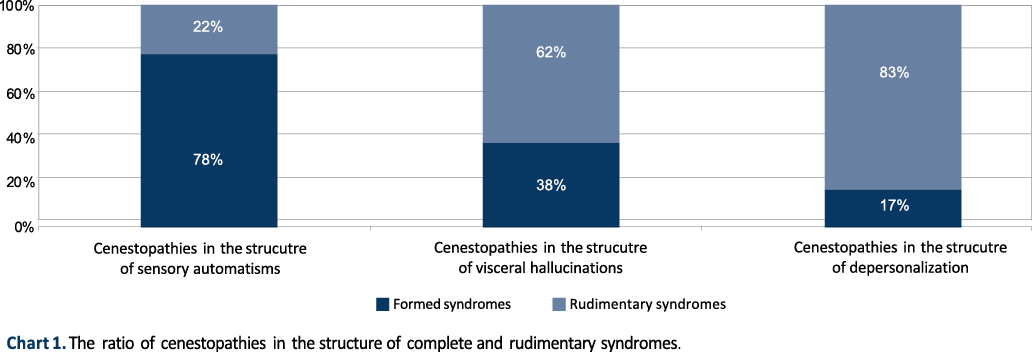
Among all cenesthopathies, pathological sensations in the structure of rudimentary sensopathic syndromes were encountered in 38.6% of cases, while cenesthopathies in the structure of formed sensopathic syndromes were registered only in 16.2% of descriptions (χ2 = 30.4; p < 0.001). For the convenience of presenting the material, we will further call cenesthopathies with accompanying bodily phenomena (depersonalization disorders of varying severity, rudimentary sensopathic syndromes and cenesthopathies within formed syndromes) – intermediate forms of cenesthopathies.
Depersonalization disorders
Cenesthopathies in the structure of depersonalization disorders of a minor degree of severity were encountered approximately five times more often (29.9% of intermediate forms of cenesthopathies) than cenesthopathies in the structure of formal depersonalization syndrome (6.2%; χ2 = 45.6; p < 0.001).
Visceral hallucinations
Cenesthopathies in the structure of rudimentary forms of visceral hallucinations and cenesthopathies in the structure of the formed syndrome were encountered with approximately the same frequency (7.5% and 4.6% of intermediate forms of cenesthopathies).
Sensory automatisms
Cenesthopathies in the structure of the formed syndrome of sensory automatism were encountered three times more often (5.8% of intermediate forms of cenesthopathies) than in the structure of rudimentary forms of automatisms (1.7%; χ2 = 5.8; p <0.05).
Chart 1 illustrates the relationship between cenesthopathies in the structure of formed sensopathic syndromes and cenesthopathies in the structure of rudimentary sensopathic syndromes.
Comparative analysis of intermediate cenesthopathies (both clinically manifested and rudimentary sensopathic syndromes)
Automatisms-hallucinations
Cenesthopathies in the structure of sensory automatisms were encountered in our study in 13.6% of intermediate forms of cenesthopathies; cenesthopathies in the structure of visceral hallucinations - in 21.9% (the difference is insignificant).
Automatisms-depersonalization
Cenesthopathies in the structure of depersonalization disorders were encountered significantly more often (65.9%) than in the structure of sensory automatisms (13.6%; χ2 = 75.3; p <0.001).
Hallucinations-depersonalization
Cenesthopathies in the structure of visceral hallucinations were encountered significantly less frequently than cenesthopathies accompanied by depersonalization disorders (21.9% and 65.9%, respectively; χ2 = 51.7; p <0.001).
Comparative analysis of rudimentary phenomena
Automatisms-hallucinations
Cenesthopathies in the structure of forms transitional to visceral hallucinations were encountered more often (19.3% of rudimentary phenomena) than cenesthopathies in the structure of incomplete sensory automatisms (4.3%; χ2 = 10.1; p <0.002).
Automatisms-depersonalization
Cenesthopathies accompanied by mild depersonalization disorders were encountered many times more often (77.4%) than cenesthopathies as part of rudimentary sensory automatisms (4.3%; χ2 = 102.9; p <0.001).
Hallucinations-depersonalization
Cenesthopathies as part of rudimentary visceral hallucinations were encountered significantly less frequently (19.3%) than cenesthopathies in the structure of mild depersonalization disorders (77.4%; χ2 = 62.8; p <0.001).
Comparative analysis of clinically manifested sensopathy syndromes
Cenesthopathies in the structure of formed syndromes were encountered with approximately the same frequency: cenesthopathies in the structure of sensory automatisms were noted in 35.9% of intermediate forms of cenesthopathies, cenesthopathies in case of visceral hallucinations - in 28.2%, cenesthopathies with depersonalization syndrome - in 38.5% of cases (without a reliable difference in the frequency of occurrence).
Comparative analysis of intermediate forms of cenesthopathies in patients of different nosological groups
Subgroup of schizophrenia
In schizophrenia, intermediate forms of cenesthopathy were encountered twice more often than cenesthopathies as a monosymptom of altered bodily perception (69% and 31% of statements, respectively; χ2 = 41.1; p < 0.001), and rudimentary sensopathy syndromes were encountered 2.5 times more often than formed ones (49.3% and 19.7%, respectively; χ2 = 27.5; p < 0.001).
Subgroup of organic disorders
Unlike the subgroup of schizophrenia, in this subgroup cenesthopathy as a monosymptom of altered bodily perception was encountered more often than intermediate forms of cenesthopathy – 62.7% and 37.3% of statements, respectively (χ2 = 8.6; p < 0.01). Moreover, unfinished bodily phenomena and formed sensopathy syndromes were encountered with the same frequency.
Subgroup of affective disorders
In affective disorders, isolated cenesthopathies were encountered 2.5 times more often than intermediate forms of cenesthopathies – 71.9% and 28.1% of statements, respectively (χ2 = 12.2; p < 0.01), and rudimentary sensopathic syndromes were encountered eight times more often than clinically formalized ones – 25% and 3.1%, respectively (χ2 = 4.6; p < 0.05).
DISCUSSION
The results of the conducted study confirmed the data of numerous publications on the fundamental heterogeneity and systematization complexity of cenesthopathies in the structure of psychopathological disorders of various nosological groups. In addition to the lack of distinct nosology-specificity of cenesthopathies, they can be included in a wide variety of syndrome variants with different degrees of structuring and phenomenological certainty, which complicates their clear clinical qualification.
In our approach to assessing the clinical material, we acted in agreement with a number of authors who consider psychopathological bodily phenomena as stages in the gradual formation of increasingly profound disturbances of the somatopsychic “Self”, as a unified spectrum of gradual transition from weakly differentiated alienation of bodily sensations to formal psychopathological syndromes, up to the formation of visceral hallucinations and sensory automatisms [9-12]. Using the term “cenesthopathies” to designate transitional forms of pathological bodily sensations, we wanted to emphasize the kinship of all pathological bodily phenomena, the actual blurring of the boundaries between cenesthopathies, somatopsychic depersonalization, visceral hallucinations and sensory automatisms.
Clinical analysis of mental disorders in the studied groups of patients showed that cenesthopathies included in the structure of complex sensopathic syndromes were more common (54.8% of cases) than cenesthopathies as a monosymptom of altered corporality (45.2% of cases). The prevalence of intermediate forms of cenesthopathies, as it turned out, were entirely due to their high frequency in the subgroup of patients with schizophrenia, in whose clinical picture cenesthopathies coexisted with other sensopathic syndromes in 82.8% of cases.
The second important result of our study was that cenesthopathies in the structure of depersonalization disorders were encountered significantly more often than cenesthopathies in the structure of sensory automatisms or visceral hallucinations (in 36% of all cases and in 66% of cases of intermediate forms of cenesthopathies). Finally, the inclusion of cenesthopathies in complex sensopathic syndromes depended both on the clinical forms of the latter and on the degree of their clinical completion: cenesthopathies that accompanied mild forms of depersonalization were encountered significantly more often than cenesthopathies accompanied by severe depersonalization syndrome. In sensory automatisms, the overwhelming majority of cenesthopathies were included in the structure of a clinically completed syndrome, and in visceral hallucinations, cenesthopathies were noted in the structure of completed and immature clinical variants with the same frequency.
The matching of the description of cenesthopathies with the three main subgroups of the main group, considering the specificities of their clinical picture, showed the following. Schizophrenia: intermediate forms of cenesthopathies were encountered significantly more often than isolated cenesthopathies; unformed bodily phenomena were encountered more often than formed ones. Organic mental disorders: isolated cenesthopathies were encountered more often than intermediate forms; formed and immature phenomena were detected with approximately equal frequency. Affective disorders: isolated cenesthopathies were encountered more often than intermediate forms; incomplete phenomena were encountered more often than formed ones.
Summarizing the above, we can come to the conclusion that the inclusion of cenesthopathies in the structure of complex sensopathic syndromes is a distinctive quality of cenesthopathies in schizophrenia, and the inclusion of cenesthopathies in clinically incomplete sensopathic phenomena is a distinctive quality of schizophrenia and affective disorders.
According to A.A. Mehrabyan, “the principles of mental alienation function at the basis of all endogenous psychopathology” [10]. The idea that disorders of the somatopsyche, from the most insignificant, clinically poorly expressed undifferentiated changes to total alienation of the somatopsychic “Self” in case of sensory automatism, represent a unified spectrum of gradual formation of increasingly deeper disorders of the somatopsychic “Self”, has been previously expressed by many authors [9-12]. The obtained results also allow us to suggest that cenesthopathies represent an intermediate link in the development of psychoses from mild forms of somatopsychic depersonalization in the direction of the formation of increasingly deeper disorders of the somatopsychic “Self”, manifested in the clinical picture by a series of gradual transitions to one of three clinical forms of sensopathy: an expanded depersonalization syndrome, sensory automatisms, or visceral hallucinations.
References
- Коцюбинский А, Скорик А, Аксенова И, Шейнина Н, Зайцев В. Шизофрения: уязвимость-диатез-стресс-заболевание. СПб: Гиппократ +, 2004. 336 с.
- Скугаревская М. Синдром ослабленного психоза – новый диагноз в психиатрии? Психиатрия и психофармакотерапия им. П.Б. Ганнушкина. 2014;2:40-43.
- Авруцкий Г. Лекарственный патоморфоз шизофрении (клинико-психопатологические закономерности). Психиатрия в России вчера и сегодня (Мат. конф. 27 сент. – 1 окт. 1992г.). Петерб. психоневрол. НИИ им. В.М.Бехтерева, 1994:11-16.
- Крылов В. Психопатология телесной перцепции. Психиатрия и психофармакотерапия им. П.Б. Ганнушкина. 2006;2:15-20.
- Давтян Е. О естественной неполноте терминов, эвфемизмах и психиатрической номенклатуре. Неврологический вестник. 2023;LV(4)56-65.
- Основы психиатрии, наркологии и психотерапии. Часть 1. М.: ИД «Городец», 2024. 712 с.
- Давтян Е, Давтян С. К эволюционной модели сенсопатических расстройств. Журнал неврологии и психиатрии им. С.С.Корсакова. 2010;3:66-76.
- Давтян Е. Клинико-семантическое исследование сенестопатий. Автореф. дисс… канд. мед. наук. СПб, 2002. 23 с.
- Снежневский А. Руководство по психиатрии. В 2 т. М.: Медицина, 1983.
- Меграбян А. Очерки по теории психологии и психиатрии. Ереван: Айастан, 1984. 193 с.
- Вертоградова О. Общие и частные вопросы учения о галлюцинациях. Вопросы общей психопатологии (иллюзии, галлюцинации, бред). Под ред. О.П. Вертоградовой. Тр.НИИ психиатрии МЗ РСФСР. М., 1976:9-14.
- Остроглазов В. Психопатология сенестопатий и галлюцинаций общего чувства. Автореф. дисс. ...канд. мед. наук. М., 1975. 24 с.